
Two studies reported on attendance requirements to meet inclusion in statistical analyses [65, 83]. Studies investigating a dance intervention lasting ≥ 4 weeks, including psychological and/or cognitive health outcomes, and having a structured exercise comparison group were included. Screening and data extraction were performed by two independent reviewers at all stages. Where appropriate, meta-analysis was performed, or an effect size estimate generated. Physical education (PE) students face a unique set of psychological stressors that distinguish them from their non-athlete peers (Figure 2; Table 1).
Selection of Psychological and Cognitive Outcome Measures
Similarly, if the extrinsic factors go away – maybe you lose weight or decide you don’t care anymore about the number on your scale – then the motivation to exercise likely disappears as well. Other people influence your attitudes and emotional responses to exercise. That is, they can affect how you feel about exercising, which is critical for determining whether you do it or not. If you get to know others who exercise regularly, you start to perceive exercise as more positive, common, desirable and doable.
Experimental design and data acquisition
Despite the proven efficacy of exercise, 25% of adults are physically inactive [20]. Further, 50% of people who start an exercise programme will cease within half a year, while the adherence rates in community-based and clinical trials are at best moderate at 52% and 66%, respectively [21, 22]. Therefore, the provision of various exercise options that facilitate higher rates of adherence is warranted. Readers should also be cautious about generalising the findings of this review when implementing dance for health in the community. When designing dance interventions, inclusion of populations underrepresented in the current literature is warranted. For clinicians prescribing dance for patients, individual preference for physical activity modality and/or dance genre may impact the potential benefits of the programme.
The primary endpoint of the study was disease-free survival compared by a stratified log-rank test performed on an intention-to-treat basis. Secondary endpoints included overall survival and patient-reported outcomes (SF-36 physical function scale was primary patient-reported outcome). The WHO Global action plan on physical activity provides policy recommendations for countries and communities to promote physical activity and ensure everyone has more opportunities to be regularly active. Improving levels of physical activity will benefit health and well-being and contribute to attainment of global NCD targets and a number of the Sustainable Development Goals.
In a recent clinical trial, NMES combined with protein supplementation preserved muscle mass but not function during 5 days of bedrest (133). However, during longer periods of unloading, protein supplementation without muscle contraction appears counterproductive (90, 134). Thus, the appropriate implementation of these countermeasures is likely dependent on a range of factors, including the duration of mechanical unloading, participant demographics, and intrinsic molecular profile of the individual. Continued efforts to characterize the molecular mechanisms underlying disuse atrophy are likely to aid in the development of more effective strategies to mitigate muscle mass and strength losses in space and on earth.
- Injury-related stress, particularly the fear of career disruption, represents a major mental health challenge for these students (15).
- In the updated exercise protocols, participants attended in groups to a spinning room.
- At the same time, many people combine cardio and strength training by participating in crossfit or certain types of high intensity interval training.
- PR has been shown to support better self-management and reduction in exacerbations, reduction in numbers of acute and emergency admissions and reduction in primary care appointments.
- Some interviewers even send the candidate the questions several days in advance.
- Instead of hammering the same tissues every session, structured plans ensure you rotate through muscle groups at an appropriate frequency.
Structured Exercise after Adjuvant Chemotherapy for Colon Cancer (CHALLENGE Trial)
As a result, we designed our own protocol and data acquisition process, collecting data from healthy participants. Research shows structured programs produce more consistent improvements in strength, fitness, and health markers than unplanned training. Random workouts will probably work in the beginning, but they often lack the progression and balance needed for long-term success.
Coaching That Helps Everyday People Win
By adopting a student-centered approach that values psychological health as much as physical performance, PE programs can transform into powerful platforms for holistic development. Ultimately, investing in the mental well-being of PE students is not merely beneficial, it is essential for nurturing resilient, high-achieving individuals who thrive both on and off the field. Beyond its neurobiological effects, exercise training enhances mental health through several key psychological mechanisms.
What is mindfulness?
But apps for fitness accountability and tracking exercise includes a wide range of activities that boost your activity level to help you feel better. When you have depression or anxiety, exercise often seems like the last thing you want to do. But once you get started and keep going, exercise can make a big difference. Exos coaches are all about partnership, so let them know how you’re feeling and they’ll offer you programming that supports how you show up that day.
This may not be unexpected, given the interest in interventions that assist in slowing down impacts of aging on cognitive and physical functioning, and enhance quality of life in older adults. The CHALLENGE trial (Canadian Cancer Trials Group CO.21) represents a pivotal, international, multicenter, randomized phase 3 study that investigated the impact of a structured physical activity program on colon cancer survivors who completed adjuvant chemotherapy. Many of the adaptations in skeletal muscle in response to exercise directly oppose factors that lead to muscle wasting (Fig. 2). The power of exercise and relative ease of accessibility clearly implicate exercise as a crucial frontline intervention to treat muscle loss in many disease states. In individuals without easy access to exercise, such as those with advance neurological diseases or injuries, improvements in exoskeleton design and battery technology may allow for rehabilitative or home use to improve health and quality of life.

Everyday benefits of mindfulness
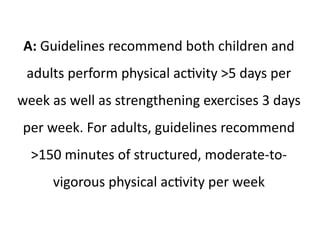
It may be that dance, like physical activity, has different impacts depending on type of dance and age [92]. The Turo group demonstrated significant time × group interactions in the psychological symptoms of somatisation and hostility compared with the control group, who performed Turo movements without the concept of meridian Qi flow. There were no significant differences in other sections of the questionnaire. Two studies found the effect of jazz dance [71] and dance-based physical education classes [82] was equivalent to standard physical education classes in primary school children for cognitive outcome measures. The WHO Global guidelines on physical activity and sedentary behaviour provide recommendations for children (age 5 and up), adolescents, adults, older adults, pregnant and post-partum women, and people living with chronic conditions and disabilities. The recommendations detail the amount of physical activity (frequency, intensity and duration) required to offer significant health benefits and to reduce health risks.
What is a structured exercise program?
Each of these four outcome measures is composed of varying domains/subscales that measure different constructs. PR services are encouraged to participate in the National Respiratory Audit Programme (NRAP) which involves data collection relating to service provision and delivery of PR services for COPD in England and Wales. We are working to extend the scope of data collection to other lung conditions. PR Services can also join the Pulmonary Rehabilitation Services Accreditation Scheme (PRSAS). The aim of the scheme is to improve the quality of pulmonary rehabilitation services throughout the UK through the process of accreditation. The scheme is run by the Royal College of Physicians and runs in collaboration with NRAP.
Availability of data and material
FAK activation is reduced after disuse (30, 41) and its activation is linked to improved IGF-1 signaling in C2C12 cell culture models (42). Other potential mechanosensors, such as the previously mentioned phosphatidic acid, the sarcomeric protein titin, and components of the z-disk, have been implicated and reviewed in detail (43–45). Since all interventions included in this review required participants to undertake supervised dance or exercise for a minimum of 6 weeks, we suggest this as a minimum period for mental health and cognitive capacity interventions. Those studies that demonstrated superior cognitive and psychological benefits in favour of dance were undertaken for a period of at least two months, two times per week, with session durations between 40 and 60 min. To systematically review the literature on the effectiveness of structured dance interventions, compared with structured exercise programmes, on psychological and cognitive outcomes across the lifespan. This inconsistency creates a “black box” of intervention details, making it impossible to determine the exact active ingredients responsible for observed mental health outcomes or to replicate successful studies with fidelity.
Studying Pneumonia in Space for Heart Health on Earth
PR is an exercise and education programme designed for people with lung disease who experience symptoms of breathlessness. Treat your prioritization system (and other internal processes) like your product. Because the “users” in this case are your team members, there should be an open channel for everyone to give feedback. Programs blending aerobic exercise with 10-min post-session meditation saw 25% greater stress resilience over 6 months (91). Coaches should model mindfulness by starting sessions with 1–2 min of diaphragmatic breathing.

Leave A Comment